


Objective
The objective of this guide is to help you understand where and how you can safely use your inflatable mat so that you can stay fun, effective, and low-impact during your training. We focus on real homes, real clubs, and real spaces, so you can set up with confidence and keep sessions enjoyable.
Key Takeaways
- The surface under your mat matters as much as the mat itself
- Indoor spaces offer control; outdoor spaces need preparation
- Avoid hard, uneven ground to keep sessions safe
- Match setup to age, skill level, and session goals
Introduction
An inflatable mat only performs as well as the surface beneath it. When placed correctly, an air track creates a forgiving, springy base that supports jumps, landings, and repeated drills with less strain on joints. Used carelessly, though, even the best mat can slip, shift, or wear faster than it should.
Did you know? Research into sports surfaces consistently shows that cushioned, impact‑absorbing bases reduce peak forces during repeated landings, especially useful for young athletes and early learners.
Let’s define the essentials. An air track is an inflatable training mat designed for tumbling, gymnastics, dance, cheer, parkour, and general conditioning. Key terms you’ll see throughout this guide include surface grip, impact absorption, clearance area, and pressure control.
Understanding these will help you choose safe locations and set up properly wherever you train.
Table of Contents
- Why Location Matters
- Safe Indoor Places
- Outdoor Use Done Right
- Surfaces to Avoid
- Age‑ and Skill‑Based Setup
- Clubs, Schools, and Shared Spaces
- Buying With Safety in Mind
- FAQs
- Train Smarter, Play Longer
- Call to Action
Why Location Matters
An inflatable mat absorbs impact, but it can’t fix an unsafe base. Slips, uneven rebound, and early wear usually trace back to poor placement rather than product quality.
How incorrect placement raises risk
- Reduced grip on glossy or dusty floors
- Uneven rebound on slopes or soft patches
- Edge movement when clearance is tight
What this really means is simple: choose a stable, flat base, and your sessions feel calmer and safer from the first jump to the last landing.
Safe Indoor Places
Indoor spaces are the easiest to manage because temperature, moisture, and ground conditions stay consistent.
Best rooms for home setups
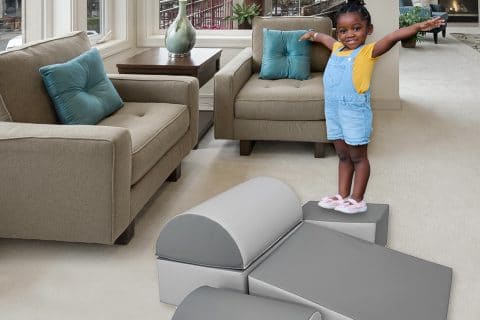
- Living rooms with furniture cleared
- Garages with clean, level floors
- Dedicated home gyms or spare rooms
Indoor flooring that works well
- Carpet (excellent grip and cushioning)
- Wood floors with a non‑slip underlay
- Gym rubber tiles laid flat
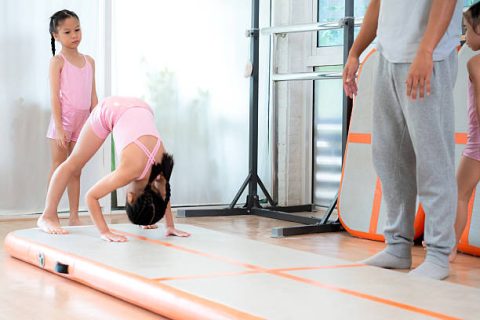
For tumbling practice and progressions, a gymnastics air track benefits from a grippy base and a little breathing room at each end.

Outdoor Use Done Right
Outdoor sessions add freedom, but they need planning.
Safe outdoor spots
- Flat lawns with short grass
- Play areas with soft ground
- Artificial turf that drains well
Weather and prep tips
- Avoid wet grass or dew; moisture reduces grip
- Clear stones, branches, and garden tools
- Set a tarp or mat underlay if the ground is uneven
Outdoor fun is brilliant when conditions are right. If not, head indoors, your joints and your mat will thank you.
Surfaces to Avoid
Some places look fine but cause problems fast.
Avoid these surfaces
- Bare concrete or paving slabs
- Gravel, pebbles, or textured stone
- Slopes, ramps, or driveways
Why do these increase the risk?
Hard bases reflect impact back into the body. Uneven ground makes the mat rock or twist. Over time, seams and edges also suffer.
Age‑ and Skill‑Based Setup
One size doesn’t fit all. Adjust the setup to the person using it.
Beginners and younger users
- Shorter mat lengths
- Extra clearance at sides and ends
- Lower pressure for a softer feel
Advanced training
- Consistent pressure checks
- Clear landing zones
- Spotting for new skills
Matching setup to ability builds confidence and reduces mishaps.
Clubs, Schools, and Shared Spaces
Professional environments often rotate stations and groups.
Smart layout choices
- Leave walkways clear
- Mark the start and finish zones
- Secure connections when linking pieces
Storage and supervision
- Deflate and roll after sessions
- Store dry and out of sunlight
- Assign a supervisor during peak use
Many clubs rely on clear routines, so everyone knows where to start, land, and exit.

Buying With Safety in Mind
The right product makes safe placement easier.
When browsing air track for sale listings or planning to buy air track gear, prioritise features that support stability and durability. The best air track isn’t just about bounce; it’s about grip, seam strength, and pressure control. Shopping for an air track online lets you compare sizes, thicknesses, and accessories that suit your space and goals.
Look for safety‑supporting features.
- Non‑slip surfaces
- Quality valves for steady pressure
- Reinforced edges and seams
A quick placement guide
| Location | Works Well? | Why | Extra Tip |
| Carpeted living room | Yes | Grip + cushioning | Clear furniture first |
| Garage (clean floor) | Yes | Flat, controlled space | Add an underlay if dusty |
| Lawn (dry, even) | Yes | Soft base | Check for moisture first |
| Concrete driveway | No | Too hard | Move indoors or add flooring |
| Sloped garden | No | Uneven rebound | Level the area or change location |
Real‑world examples
- The parent said that moving the mat from wooden boards to carpet immediately reduced slips.
- When clearance zones were standardised at each mat end, coaches noted fewer minor knocks.
Small changes make big differences.
Train Smarter, Play Longer
Used thoughtfully, your training mat becomes a reliable base for learning and fun. The Air track earns its place by offering comfort, confidence, and consistency when you choose the right spot and set it up well.
For many households and clubs, products from AirTumble are popular because they’re designed for both indoor and outdoor use and made with durable materials suited to repeated sessions. With sensible placement and regular checks, your setup stays safe and enjoyable.
Conclusion
Where do you place your mat shapes every session? Choose flat, grippy surfaces indoors or well‑prepared spots outdoors. Avoid hard or uneven ground. Adjust pressure and space for the user. Follow these steps, and your Air track supports progress without unnecessary risk.
Call to Action
Ready to train with confidence? Explore the range at AirTumble Track Range and choose a mat that fits your space and goals. Set it up right, train safely, and enjoy every bounce. For more information, contact us today.
Frequently Asked Questions
Can I place it directly on a hard floor?
You can, but add a non‑slip underlay to reduce movement and soften impact.
Is it safe outside?
Yes, when the ground is flat, dry, and clear of debris.
How much space should I leave around it?
Aim for at least one metre of clear space on all sides.
Can more than one person use it at once?
Take turns unless supervised, and keep clear zones free.


Leave a comment